TradeUP Stock Trading Simulator
TradeUP Stock Trading Simulator made financial education fun and risk-free by leading the product design of a gamified investing app for teens, using simulation, progressive challenges, and user feedback to boost confidence and retention.
Bootcamp Simulation
Product & Project Management
FinTech
Design & Prototyping
Design Thinking
Product Design
UX
UI
Project Overview
Client: Bootcamp Capstone
Industry: FinTech EdTech
Timeline: August 2025
Role: Product Owner · UX Strategist
As part of my Product Management bootcamp capstone, my team and I designed TradeUP, a gamified stock trading simulator that helps teens and young adults learn investing in a fun, risk-free, and educational environment.
We noticed that while Gen Z wants to grow their financial literacy, most existing platforms are either intimidating, overly technical, or tied to real money. Our goal was to bridge fintech with game-based learning, using design to make investing accessible, safe, and empowering.
The Problem
Finance is intimidating "Especially for beginners".
Our user research revealed three major pain points:
Fear of losing money or making beginner mistakes
Overly complex language in most finance learning platforms
Lack of motivation due to boring or lecture-based teaching styles
There was a clear opportunity: create a simulation app that allows users to experiment, play, and learn without any financial risk - where education feels like progress in a game, not a classroom.
Discovery & Research
Step 1: Understanding User Anxiety
We conducted surveys and interviews with high school and college students who expressed interest in investing but hadn’t started.
Using Empathy Mapping and Jobs to Be Done (JTBD) frameworks, we discovered:
They wanted a space to learn by doing, not reading.
They desired instant feedback and visible progress.
They needed safety and emotional reassurance before engaging with real markets.
Step 2: Competitor Analysis
We analyzed apps like Robinhood, Fedility, and Stock Market Game, focusing on UX patterns, learning features, and emotional design.
Most apps either:
Focused on real-money trading (risk involved), or
Offered static simulations with poor engagement.
This gap inspired our product vision - a game-based simulator with real-time data, zero risk, and motivational UX that nurtures user confidence step by step.
Ideation & Design Process
To structure our creative process, I facilitated multiple design-thinking workshops, including:
Remember the Future: envisioning what success looks like when users feel confident to invest in real markets.
MoSCoW Prioritization: identifying Must-Haves, Should-Haves, and Could-Haves for our MVP.
Speedboat & Prune the Product Tree: uncovering feature pain points and mapping how improvements could “pull the boat forward.”
Persona Development: defining three user personas based on age, goals, and financial comfort levels.
From these sessions, we mapped an experience where users unlock new levels, earn badges, and build their confidence through small, safe wins.
The Solution
TradeUP is a mobile learning platform that teaches users how to invest by playing real-time trading challenges using virtual currency.
Each level integrates financial concepts, bite-sized lessons, and missions that simulate real market conditions. Users can:
Practice trading with real data, fake money
Complete daily challenges to reinforce key concepts
Track progress through XP points and achievement badges
The app creates a safe learning loop that builds financial confidence while keeping engagement high.
Low-Fidelity Prototype
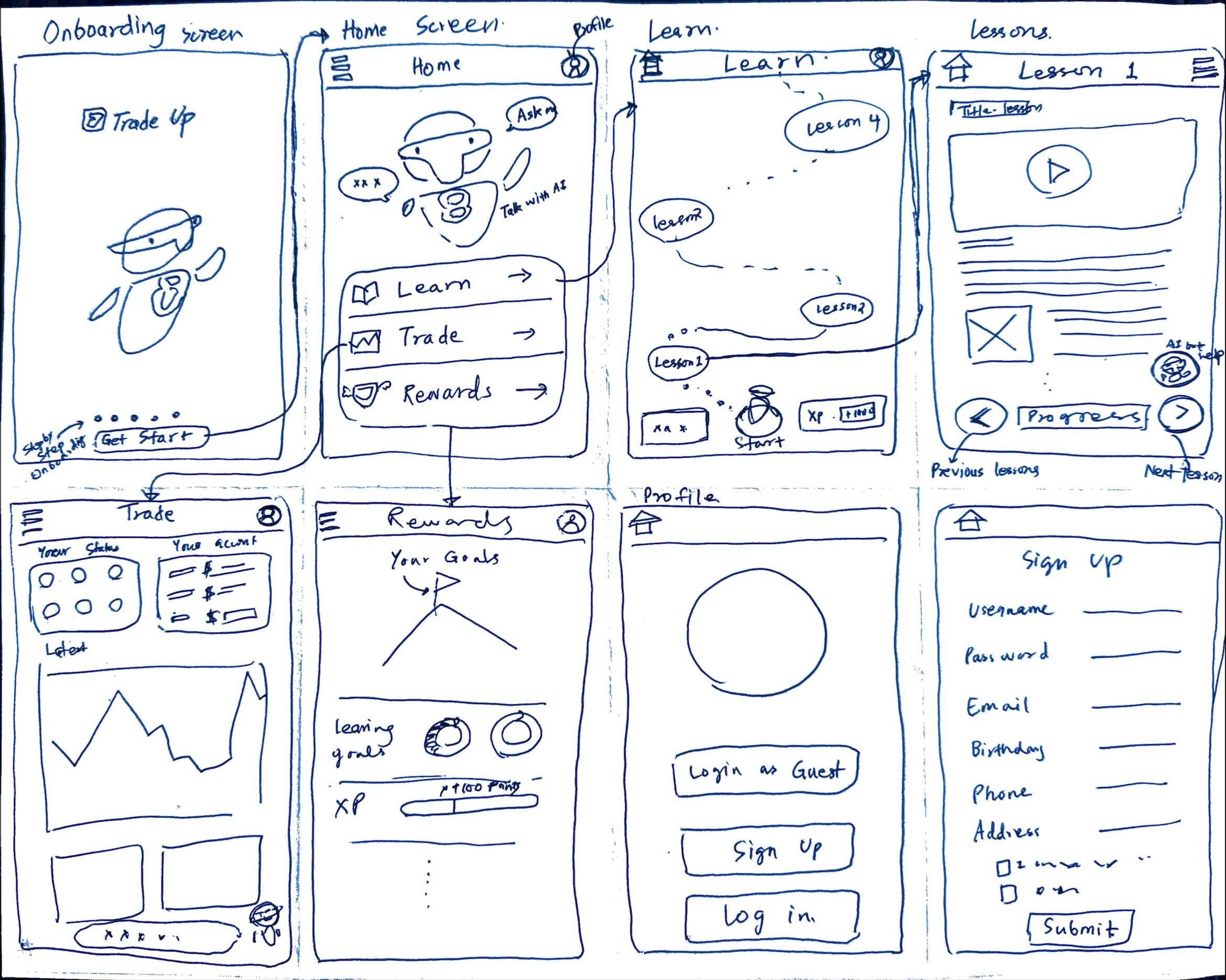
Our final deliverable was a Lo-Fi wireframe prototype showcasing:
Onboarding flow introducing the “learn by doing” concept
Home dashboard with portfolio simulation and progress tracker
Challenge center with tiered levels and XP rewards
Learning hub for quick, gamified lessons
We used Miro for mapping, Google Suite for documentation, and applied Agile sprints to coordinate design iterations.
Tools & Frameworks
Miro – journey mapping & team brainstorming
Google Suite – documentation & presentation
MoSCoW – feature prioritization
Prune the Product Tree – feature mapping
Remember the Future – success visioning
Agile Planning & Delivery – sprint management
MVP Definition – tradeoffs, constraints, success metrics
Competitive Analysis & Market Research
Impact & Learnings
This project gave me hands-on experience in end-to-end product thinking — from problem discovery to early prototyping. I learned how to:
Translate complex ideas (finance) into playful learning experiences.
Use UX frameworks to guide team discussions and product direction.
Balance user needs, business goals, and technical constraints in MVP scoping.
Working with a cross-functional team taught me to facilitate collaboration, manage different opinions, and adapt quickly under tight timelines.
Most importantly, I saw how thoughtful design and product strategy can make intimidating topics feel approachable, fun, and empowering.
Next Steps
If developed further, our next iterations would focus on:
Integrating AI coaching to provide personalized learning paths
Building a community leaderboard to motivate continued play
Testing high-fidelity prototypes with real users for usability insightsOur Project Presentation