CiaoLINK – Localizing FinTech Experiences for Emerging Markets
SEA Market & Payment Research increased campaign engagement by localizing promos and payment flows based on cultural insights from users in Myanmar, India, Thailand, and the Philippines.
CiaoLINK
FinTech
Payment UX
Market Localization
Client: CiaoLINK FinTech
Industry: FinTech · Payment UX · Market Localization
Timeline: 2019–2023
Role: Product Manager (Market Research · Cultural Insight · Payment UX · Southeast Asia Localization)
Overview
During CiaoLINK’s expansion into Southeast Asian markets including Myanmar, India, Thailand, and the Philippines, I led a cross-functional initiative to localize payment experiences and promotional strategies.
Our goal was to understand how cultural context, payment behavior, and digital trust influenced user engagement and conversion. Through data-driven research, user interviews, and A/B testing, we identified high-impact opportunities to optimize both promotional timing and checkout flows, resulting in a 15% increase in campaign engagement and improved payment success rates across multiple regions.
The Problem
Despite strong downloads and engagement in Vietnam, the app’s expansion markets were struggling.
We noticed:
Low promo participation in Myanmar, India, and the Philippines
High drop-off rates at checkout, especially during in-app promotions
Frequent user complaints about payment failures and unavailable options
The challenge was that we had limited visibility into why users were disengaging, and the team needed localized insights to design for these new markets.
Discovery & Research
Step 1: Framing the Problem
I collaborated with the data analytics team to segment user behavior by region.
Through funnel analysis, we found:
Major drop-offs during the promotional offer page and payment step
Conversion rates varied drastically, with Myanmar and India having less than 50% completion
This revealed a clear friction point where users were reaching the payment gateway but failing to complete the transaction.
Step 2: Listening Locally
To understand the “why,” I conducted qualitative research:
User interviews via online communities and forums in each market
Surveys through SurveyMonkey focused on trust, payment preferences, and cultural timing of spending
Partner calls with regional payment gateways to identify API or availability issues
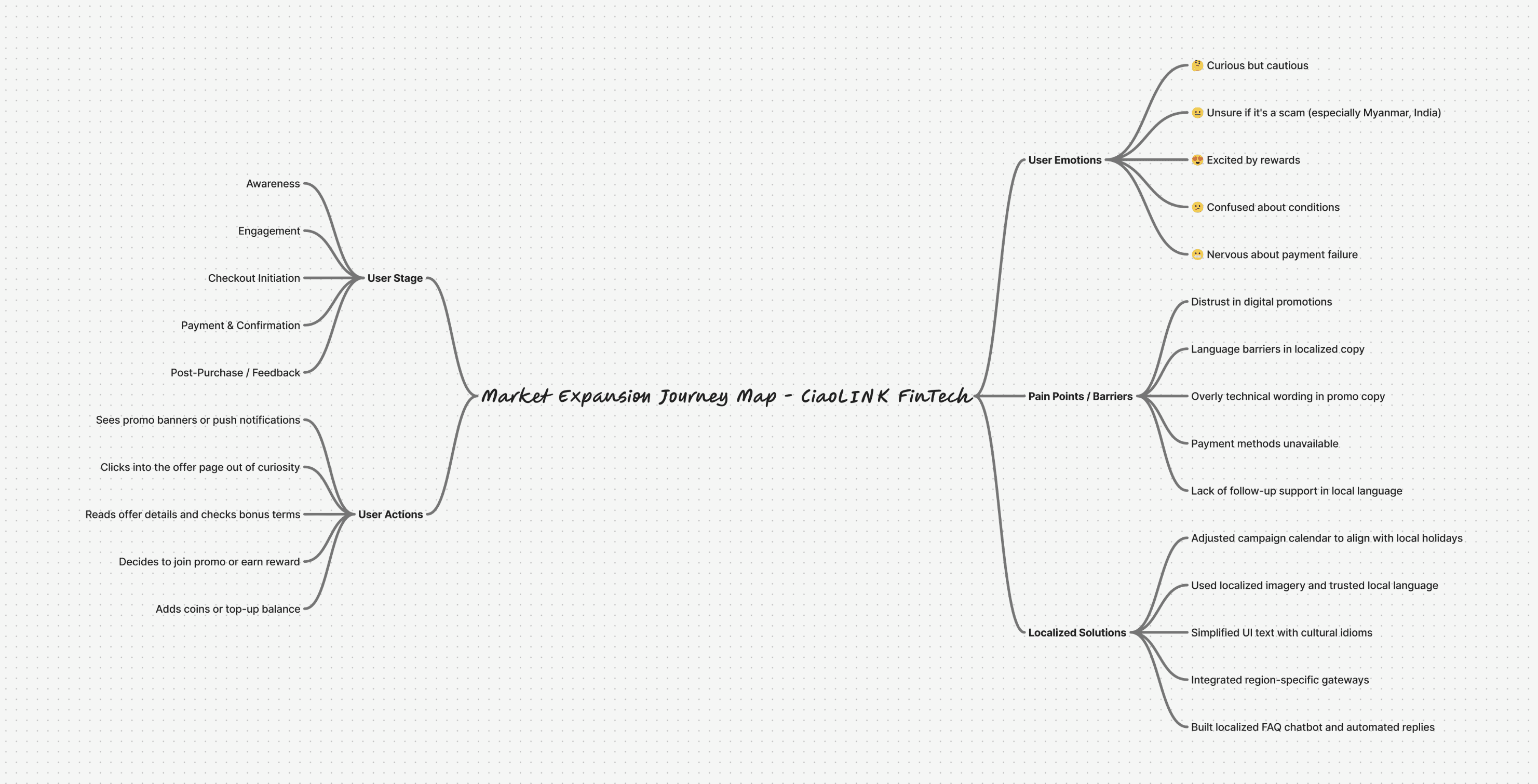
The insights revealed that digital payment distrust was high in Myanmar and India, with users preferring cash-based or wallet solutions. Promotional timing did not align with local pay cycles or cultural events, and UI terms like “bonus coins” didn’t translate emotionally or contextually across languages.
Ideation & Strategy
I facilitated a whiteboard workshop with our marketing and development teams to co-create localization strategies.
We mapped:
Cultural calendars such as Thingyan in Myanmar, Diwali in India, and Songkran in Thailand
Popular digital wallets and mobile money providers like WavePay, GCash, and Paytm
Spending habits and peak transaction hours
Using Affinity Clustering and Persona Mapping, we grouped insights into actionable themes:
When people spend (timing of promotions)
How people pay (preferred methods)
Why people trust (language, local relevance, UI tone)
The Solution
I developed Regional Playbooks to guide both product and marketing teams in designing market-specific strategies.
Each playbook included:
Top holidays and pay cycles relevant for promotion timing
Preferred payment gateways and success rate benchmarks
Localized UI and messaging guidelines
Campaign templates matched to cultural contexts
We ran A/B tests to validate:
Different promo cadences such as weekly versus event-based
Localized language and visuals for banners and notifications
Payment gateway combinations for higher transaction success
Results & Impact
Our pilot rollout achieved:
A 15% increase in promotional engagement
A 20% improvement in payment completion rates in Myanmar, India, and Thailand
Three of four markets showing measurable lift in both user retention and in-app purchase volume
Most importantly, the framework became a blueprint for future regional launches, integrating cultural insight into the company’s overall product expansion strategy.
Tools & Frameworks
SurveyMonkey – user surveys and behavior insights
Google Sheets – data tracking and comparative analysis
Persona Mapping – identifying user needs by region
Affinity Clustering – organizing qualitative insights
Market Landscape Analysis – identifying competitors and gaps
Cross-Functional Collaboration – between product, dev, and marketing teams
What I Learned
Localization is not just translating text; it is translating trust.
Each market functions like its own product ecosystem with unique motivators, fears, and digital norms.
This project taught me to:
Treat each region as a user persona, not a single demographic
Leverage both data and empathy to shape design and product decisions
Build scalable frameworks that blend business goals with cultural authenticity
This experience deepened my understanding of global product strategy and how culture, UX, and payment design can come together to create truly inclusive technology.